
One wrong move with a “nest” in the loft can turn a quiet afternoon into a frantic dash indoors, especially if you’re dealing with wasps rather than bees. The tricky part is that a wasp nest and a bee hive can look similar from a distance, but the right response is very different for safety, legality, and wildlife. In this guide to Wasp Nests vs. Bee Hives: Spotting the Difference, we’ll show you ten clear clues you can use in 2026 to identify what you’re seeing without getting too close.
Key Takeaways
- Correctly identifying wasp nests versus bee hives is crucial for safety, protecting beneficial pollinators, and complying with legal responsibilities.
- Wasp nests are typically made of a grey, papery material and often found under eaves, in lofts, or shed roofs, while bee hives are made of wax honeycomb and usually occupy enclosed cavities like chimney voids or hollow trees.
- Wasps can sting multiple times and become aggressive if disturbed, so maintaining a safe distance and observing from afar is essential, especially if the nest is near common areas.
- Bee colonies are larger, with steady, purposeful flight carrying pollen, highlighting their importance as pollinators and the need to avoid harming them unnecessarily.
- Seasonal patterns help identify and assess risk: wasp activity peaks in summer and diminishes in winter, whereas bee colonies can persist year-round.
- When in doubt or facing high-risk situations like nests in walls or allergies, contacting a pest control professional ensures safe, species-appropriate management.
Why Correct Identification Matters (Safety, Pollinators, And Legal Duties)
A rushed guess can cost you, either in stings or in accidentally destroying a protected pollinator colony. If we treat a bee hive like a wasp nest and spray it, we can trigger defensive behaviour, kill thousands of beneficial insects, and still fail to solve the problem if the colony is inside a wall void.
From a safety angle, the difference matters because a wasp can sting multiple times and may mobilise the whole nest if disturbed. A honey bee usually stings to defend the colony and, for many honey bees, the sting is a one-time event, still serious, but the pattern of aggression is often different. For anyone with allergies, that difference becomes urgent: a single sting can cause an anaphylactic reaction, so correct identification is not a “nice to have”.
There’s also the bigger picture. Bee species are key pollinators for gardens, allotments, and local crops. If we misidentify a bee nest and destroy it, we don’t just remove an insect problem, we remove a working pollination workforce from the neighbourhood.
And then there are legal and duty-of-care issues. In the UK, some wildlife protections apply in specific contexts (for example, nesting sites in certain situations), and many councils and landowners have policies that favour humane removal or relocation where possible, especially for bees. If you’re a business owner, landlord, or managing agent, correct identification supports a sensible risk assessment and helps you justify the right action.
If you already know you’re dealing with stinging insects around a property, the safest next step is usually to get advice early. A specialist can talk you through options or attend if needed, wasp and hornet control for the sort of scenarios professionals handle daily.
Where You’ll Find Them: Typical Locations Around Homes, Gardens, And Buildings
Location is often the first clue, because each insect chooses nest sites that match how it builds and defends its home. If we spot activity in a very specific “hotspot” around the property, we can narrow down whether it’s a wasp nest, a bee hive, or a solitary nester.
Wasp nests commonly show up in places that feel annoyingly close to people: under eaves, in shed roofs, inside lofts, behind fascia boards, in dense hedges, and even in compost bins. A classic scenario is a steady stream of wasps using a small gap where roof tiles meet soffits, like a tiny doorway they guard.
Bee hives (especially honey bee colonies) often favour enclosed cavities: inside a chimney void, behind brickwork (through a weep hole), within a hollow tree, or in a wall cavity that stays dry and stable. If we hear a deeper, steadier buzzing through plasterboard or near a fireplace breast on a warm day, that can point to bees living inside the structure rather than hanging an exposed nest.
For gardens, pay attention to ground-level entrances. Yellow jacket-type wasps (often referred to in UK conversations as ground-nesting wasps) can use old rodent burrows or gaps under paving slabs. The “tell” is a small hole in soil with frequent in-and-out traffic, often near a patio edge where people walk barefoot.
A practical step: stand well back (several metres) and watch the approach route. If insects repeatedly disappear into the same crack in brickwork, that’s a strong sign of a hidden nest site and a reason to avoid DIY poking. If the problem sits in a workplace, school, or customer area, it’s also worth looking at broader prevention, good sealing and proofing reduces repeat issues, which is the focus of services like pest proofing.
What They’re Made Of: Paper, Wax, Mud, And What Each Material Means
Material is one of the safest “distance checks” we can do, because you don’t need to touch anything to get a strong clue. If we can see the nest surface clearly (binoculars help), the texture and colour usually reveal who built it.
Paper (wasps)
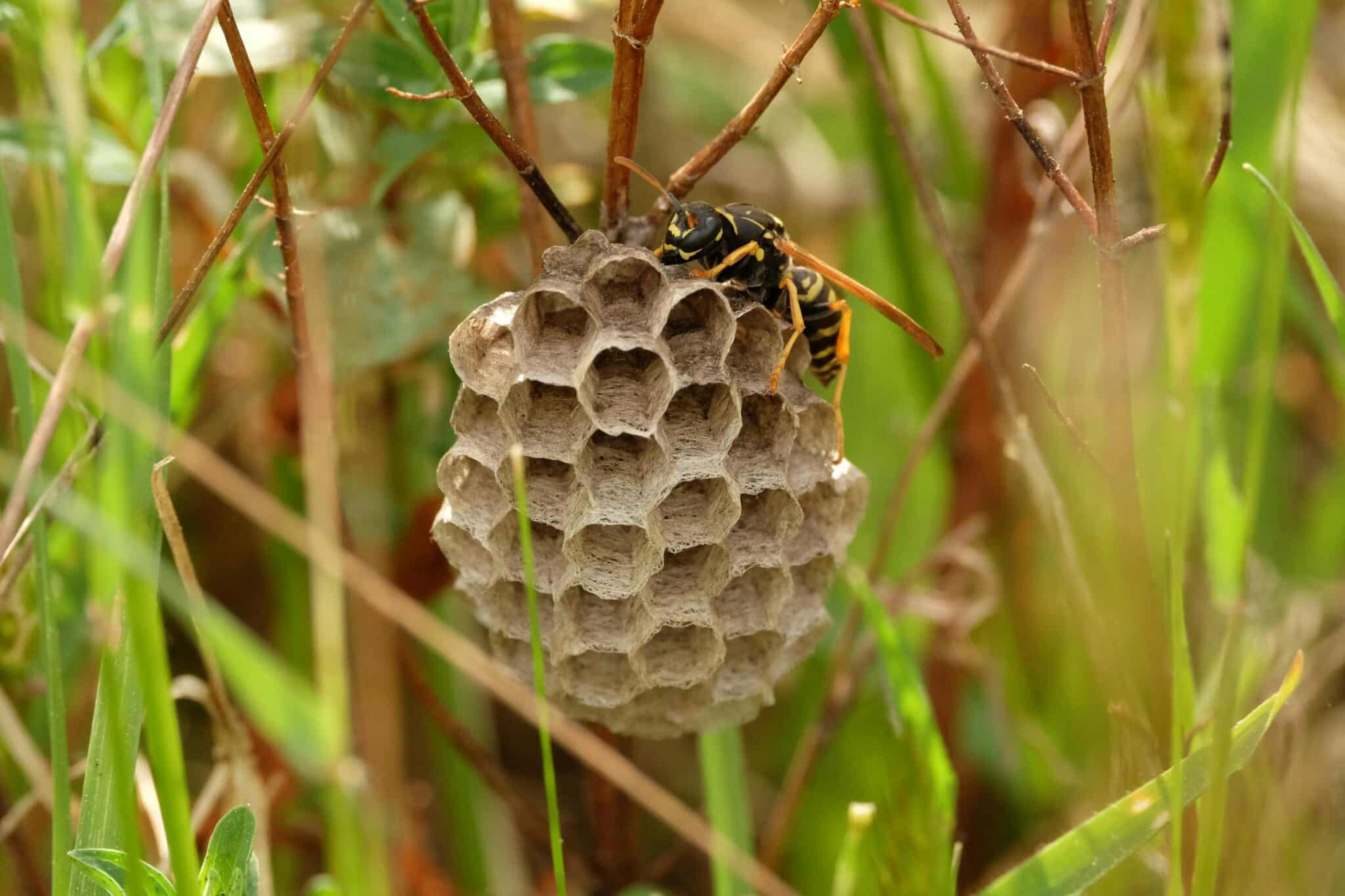
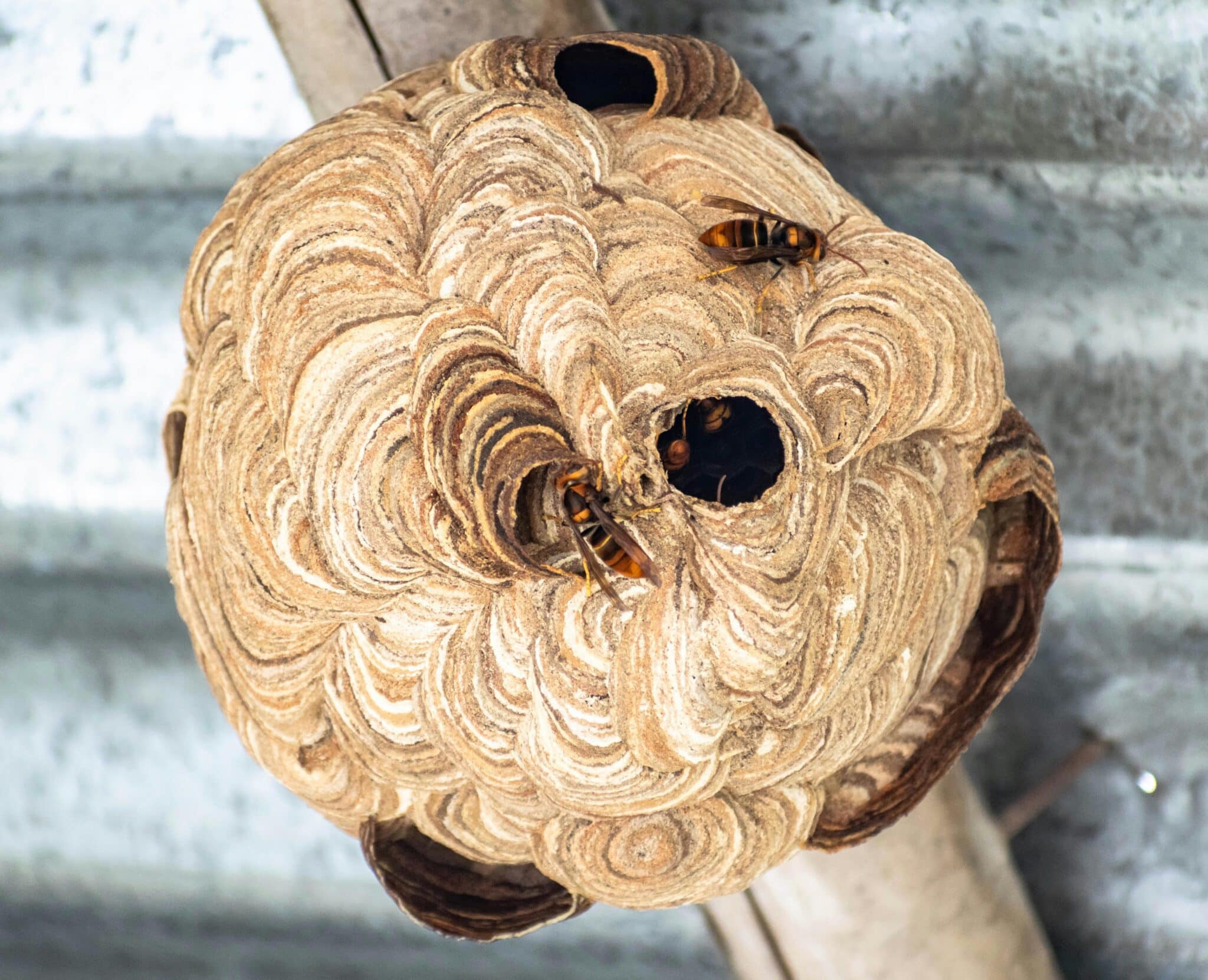
If the nest looks grey, papery, and layered, we’re often looking at a wasp nest. Wasps make this by chewing weathered wood fibres and mixing them with saliva, creating a light paper shell. In practical terms, it can resemble a small football made of thin card, with subtle swirls like woodgrain. If we see that distinctive paper look under eaves or in a shed corner, wasp is the front-runner.
Wax and honeycomb (honey bees)
If we can see wax comb, often golden, cream, or light tan, we’re in bee territory. Honey bees produce wax and build hexagonal cells. In an open view (for example, if a panel has fallen away in a loft), the comb looks like stacked sheets or curtains of honeycomb rather than a papery shell. If you notice sticky residue, a sweet smell, or drips on warm days, that’s another concrete sign of honey bee activity inside a cavity.
Mud or resin (some solitary bees)
If the “nest” is actually little mud tubes on brickwork, window frames, or sheltered corners, that’s often a solitary bee or wasp species using mud partitions for individual larvae. These don’t behave like large colonies, and the response is usually different. A carpenter bee (less common in the UK than in warmer regions, but still discussed often online) doesn’t build paper nests: it uses wood and leaves neat, round holes, another reason material matters.
A safe action step: take a photo from a distance, then zoom in to inspect surface texture on your phone. If the structure is papery and enclosed, avoid vibrations (like slamming doors in a shed) because wasps can react to disturbance even without direct contact.
Shape And Structure: Open Comb, Enclosed Balls, And Tubes
Shape is the clue most people try to use first, and it’s useful, as long as we don’t get lured into standing too close “just to check”. The outer silhouette and the way entrances work can separate a bee hive from a wasp nest quickly.
Enclosed balls and teardrops (wasp nest)
Many social wasps build an enclosed shell. From the outside, it may look like a round ball, a rugby ball, or a teardrop shape tucked into a corner. The entrance is often a single opening near the bottom or side, sometimes hidden from view if the nest sits inside a cavity. If we can see a defined outer layer, think wasp.
Open comb or exposed sheets (bees)
Bees are more likely to show open comb if the colony is exposed (for example, a swarm clustering temporarily on a branch) or if a structure has been opened up. Honeycomb appears as organised sheets of hexagons. Importantly, a honey bee swarm is not a nest, it’s a temporary cluster while scout bees look for a permanent cavity. If we see a “hanging bunch” of bees like a living pinecone on a tree for a day or two, that can be a swarm rather than a settled hive.
Tubes, holes, and little cells (solitary nesters)
If we notice small tubes of mud or a series of pencil-width holes in soft mortar or timber, we may be seeing solitary insects. These do not form large defensive colonies. You might see one insect arriving every few minutes rather than a constant stream.
Actionable check: look for the number of entrances. A single, defended doorway suggests a social colony (often wasps). Multiple tiny holes spread across a patch of mortar suggests solitary nesting. Either way, avoid blocking entrances: trapped insects often look for a new route indoors.
Who Lives There: Colony Size, Roles, And How Fast They Expand
If we only judge by one insect flying past our drink, we miss the bigger clue: colony scale. The number of insects and the “pace” of activity around the nest can tell us a lot about whether we’re looking at bees, wasps, or something else.
Honey bees: big colonies with clear roles
A honey bee colony can reach many thousands of bees at its peak in summer. We often see steady traffic, but it looks purposeful: bees arrive with pollen baskets on their legs, then disappear into a cavity. The social structure is stable, queen, workers, drones, and the colony can persist year to year if the hive survives winter.
A concrete example: if we stand back from a wall and see a constant flow of insects, roughly one every second or two, all using the same gap and carrying pollen (yellow or orange dust on their hind legs), that’s classic honey bee foraging behaviour.
Wasps: smaller colonies, faster mood swings
A wasp nest usually starts with a single queen in spring and expands quickly as workers hatch. Peak numbers are often hundreds to low thousands depending on species and conditions. The key lived experience is this: wasps can shift from calm to confrontational fast if the nest feels threatened. Late summer also changes their behaviour, because natural food sources dip and they start scavenging.
A practical clue: if you see lots of wasps repeatedly searching around bins, picnic tables, meat scraps, or sugary drinks, and then you notice a nearby entrance under eaves, the colony is likely established.
Bumble bees and solitary bees: smaller, often quieter
A bumble bee nest is usually much smaller than a honey bee hive, often in old burrows or compost. Activity can look gentle and intermittent, with fewer individuals at the entrance. Solitary bees (and solitary wasps) don’t form a big defensive crowd: they provision individual cells.
Action step: count for 60 seconds from a safe distance. If you see 50+ entries/exits in a minute from one spot, treat it as a serious colony and keep people and pets away until you identify it properly.
Flight Patterns And Behaviour: What You’ll See At The Entrance
Behaviour at the entrance is often the most reliable clue when the nest itself is hidden. If we can’t see the structure, we can still read the “traffic pattern” without putting ourselves at risk.
Bees fly like commuters
Bees tend to move with a steadier, more direct flight. They often arrive from flower-rich routes, lavender borders, fruit trees, oilseed rape fields, then land and walk in. On warm days, you may also see “orientation flights”, where young bees hover in arcs facing the entrance as they learn landmarks.
Concrete detail: bees often carry pollen. If we see that dusty yellow load on their back legs, it’s a strong sign we’re dealing with bees and should avoid any insecticide.
Wasps fly like patrols
Wasps often show a more darting, zig-zag style near people and food. Around an entrance, you might see them hover, pivot, and react to movement. Guard behaviour can look like one or two wasps hanging near the opening, then chasing anything that gets close.
A vivid scenario: if someone opens a shed door and three or four insects immediately fly out and circle the doorway at head height, we should step back and close up slowly. That quick defensive response is more typical of wasps.
Leg position and body shape (a quick visual check)
If we catch a clear view, wasps often look slimmer with a defined waist, while many bees look rounder and hairier. Some people also notice that certain wasps hold their legs slightly differently in flight, but body shape and behaviour are usually easier clues than leg position.
Action step: keep a minimum distance (at least 3–5 metres outdoors). Use your phone zoom rather than walking closer. If the entrance is indoors (loft hatch, air vent, wall crack), keep that room shut and stop using aerosols, sprays can drive insects into living spaces.
Seasonal Timeline: When Nests Appear, Peak, And Die Back
Timing can stop us making the wrong call. If we know what normally happens through the year, we can predict whether the problem will naturally fade, or whether it will grow rapidly unless we act.
Spring: queens start small
In spring, a queen wasp may start a nest in a roof void or shed, and numbers can be low at first. That’s why people sometimes dismiss early signs as “just a few”. With bees, spring can bring swarming, where a large cluster gathers temporarily on a branch while they search for a new home.
Actionable clue: a sudden mass of bees on a tree in May or June that appears overnight is often a swarm, not a settled hive. It may move on within 24–72 hours.
Summer: peak activity and higher risk
Summer is when both wasp nests and bee colonies reach their busiest phase. Wasp colonies expand, and human-wasp conflict rises because we spend more time outdoors. Honey bees forage heavily and may be visible from morning to early evening in warm, still weather.
Concrete scenario: if you notice escalating wasp interest around meals in August, and at the same time you see a strong flight line to a particular roof edge, you’re likely seeing peak wasp season.
Autumn: wasps become more nuisance-driven
In early autumn, wasps often turn to scavenging as their natural prey sources drop. The colony’s internal “purpose” changes, and they can seem more persistent around sweet drinks and fallen fruit. Honey bee colonies stay active but shift focus to winter stores.
Winter: many wasp nests die back, bee colonies may persist
Most social wasp nests do not survive winter: the workers die off and only queens overwinter elsewhere. That means an old paper nest in a shed in January is usually inactive, still not a toy, but less of a live threat. Honey bee colonies can survive winter inside their cavity, which is why a bee hive in a wall can be a year-round issue.
Action step: don’t assume “cold weather means safe”. A mild winter day can still prompt activity, and disturbing a dormant nest site can cause insects to emerge if temperatures rise.
Common Lookalikes: Hoverflies, Hornets, Bumblebees, And Solitary Nesters
Misidentification often happens because we see stripes and panic. But several harmless or less risky insects mimic the look of a wasp, and some stinging insects behave very differently from what people expect.
Hoverflies: the harmless mimics
Hoverflies can look like small wasps, with yellow-and-black markings, but they have key differences. They often hover almost motionless, then dart away, and they don’t show the same aggressive interest in meat or fizzy drinks. A concrete check: hoverflies have large, prominent eyes and typically don’t have the narrow “wasp waist” look.
Hornets: bigger, not automatically worse
Hornets are larger than common wasps and can alarm people fast. They can defend nests, so we treat them with respect, but they’re not always more aggressive than wasps in every context. If the insect is noticeably larger with a deeper buzz and you see activity near tree hollows or roof spaces, we may be dealing with hornets and should avoid DIY disturbance.
Bumble bees: rounder, fuzzier, smaller nests
Bumblebees look stockier and very hairy, often with a gentle flight and a lower buzz. Their nests are usually small and hidden (compost heaps, under sheds, old burrows). If we see a few bumblebees using a ground gap but no frantic defensive response, it may be best to leave them alone.
Solitary bees and “carpenter bee” confusion
Many solitary bees use holes in mortar, sandy banks, or timber. People sometimes label any neat hole in wood as a “carpenter bee” issue, but in the UK it’s more often other species or simple wood damage. The key behaviour difference is the lack of a large, defended colony: you’ll see one insect at a time provisioning a nest.
Action step: if you’re unsure, record a 10-second video from a safe distance. The flight style (hovering vs commuting vs patrolling) is often clearer in video than in a still photo.
What To Do Next: Observe Safely, When To Leave It Alone, And When To Call A Professional
The biggest risk comes from the “quick fix” mindset, spraying first and asking questions later. If we want a safe outcome for our household, neighbours, and pollinators, we need a calm, repeatable approach.
Step 1: Create a safety buffer immediately
If the nest is near a doorway, play area, or footpath, set a clear exclusion zone. A simple, concrete step is to keep people and pets at least 5 metres away outdoors and close internal doors if activity is in wall voids or lofts.
Step 2: Observe without provoking
We can gather useful information in two minutes:
- Watch the entrance line from a distance and note the exact gap they use.
- Count entries/exits for 60 seconds to estimate colony strength.
- Look for pollen loads (bees) versus scavenging behaviour around bins (wasps).
- Photograph or film using zoom, no ladders, no poking, no torching into a cavity.
Step 3: Decide whether to leave it alone
It can be reasonable to leave a nest alone when:
- It’s clearly bumble bee or solitary activity away from busy areas.
- It poses low contact risk (for example, high in a tree line at the far end of a garden).
- It’s late in the season and wasp activity is already dropping.
Concrete example: a small bumblebee nest at the back of a compost heap in September, with a few calm bees entering, might be best left undisturbed until it naturally finishes.
Step 4: Know when to call a professional
We should call for help when:
- The nest sits in a wall cavity, loft, chimney, or near electrics.
- Anyone in the home has a known sting allergy.
- The entrance is by a front door, school route, or business premises.
- We can’t confidently tell whether it’s a wasp nest or a bee hive.
Professionals will also advise on species-appropriate handling, wasp nest treatment is very different from bee relocation, and the wrong approach can push insects into living spaces.
If you need a quick route to support, use insect control services for general infestations, or go straight to specialist help for stinging insects via wasp and hornet control.
Conclusion
When we spot activity around a property, the safest win is not speed, it’s accuracy. If we use the ten clues in this guide (location, material, shape, colony size, entrance behaviour, season, and lookalikes), we can usually tell whether we’re dealing with a wasp nest, a bee hive, or a quieter solitary nester without taking risks. From there, the right next step becomes obvious: leave low-risk pollinators alone, protect people where stings are likely, and bring in a professional when the nest is hidden, busy, or close to daily foot traffic.
Frequently Asked Questions about Wasp Nests and Bee Hives
What are the main differences between a wasp nest and a bee hive?
Wasp nests are grey, papery structures made from chewed wood fibres, usually housing a few hundred wasps. Bee hives are waxy, golden, and built from hexagonal honeycomb cells, supporting thousands of bees. Their locations and colony sizes also differ significantly.
Why is it important to correctly identify wasp nests versus bee hives?
Correct identification ensures safety, as wasps can sting multiple times and are more aggressive, while bees usually sting once and are vital pollinators. Misidentifying bees can lead to unnecessary destruction of valuable colonies, which also involves legal and environmental concerns.
Where are wasp nests and bee hives commonly found around homes?
Wasps often build nests under eaves, in lofts, behind fascia boards, or in sheds. Bees prefer enclosed cavities like chimney voids, wall cavities, hollow trees, or roof spaces that offer dry, stable conditions.
How can I safely observe a suspected wasp nest or bee hive?
Maintain a safe distance of at least 3–5 metres. Use zoom on your phone or binoculars to inspect the nest’s material and shape. Avoid loud noises or vibrations near the nest, and never attempt to poke or disturb it yourself.
When should I call a professional to handle a wasp nest or bee hive?
Call professional help if the nest is in inaccessible spots like wall cavities, lofts, or chimneys, if there are allergy risks, near busy entrances, or if you cannot confidently identify the insect type. Professionals ensure safe, humane, and legal removal or relocation.
What are the typical behaviours that differentiate wasps from bees around their nests?
Bees fly steadily and carry pollen on their hind legs, visiting flowers. Wasps have quick, darting flight patterns, hover near food sources such as bins or sugary drinks, and can become defensive rapidly if disturbed.